
University Rector explains why top students struggle in the workplace
Original Vietnamese title: Hiệu trưởng đại học lý giải vì sao sinh viên học giỏi vẫn lúng túng khi đi làm
Top-performing university graduates may still stumble in the workplace because classroom knowledge alone is insufficient to navigate complex real-world situations.
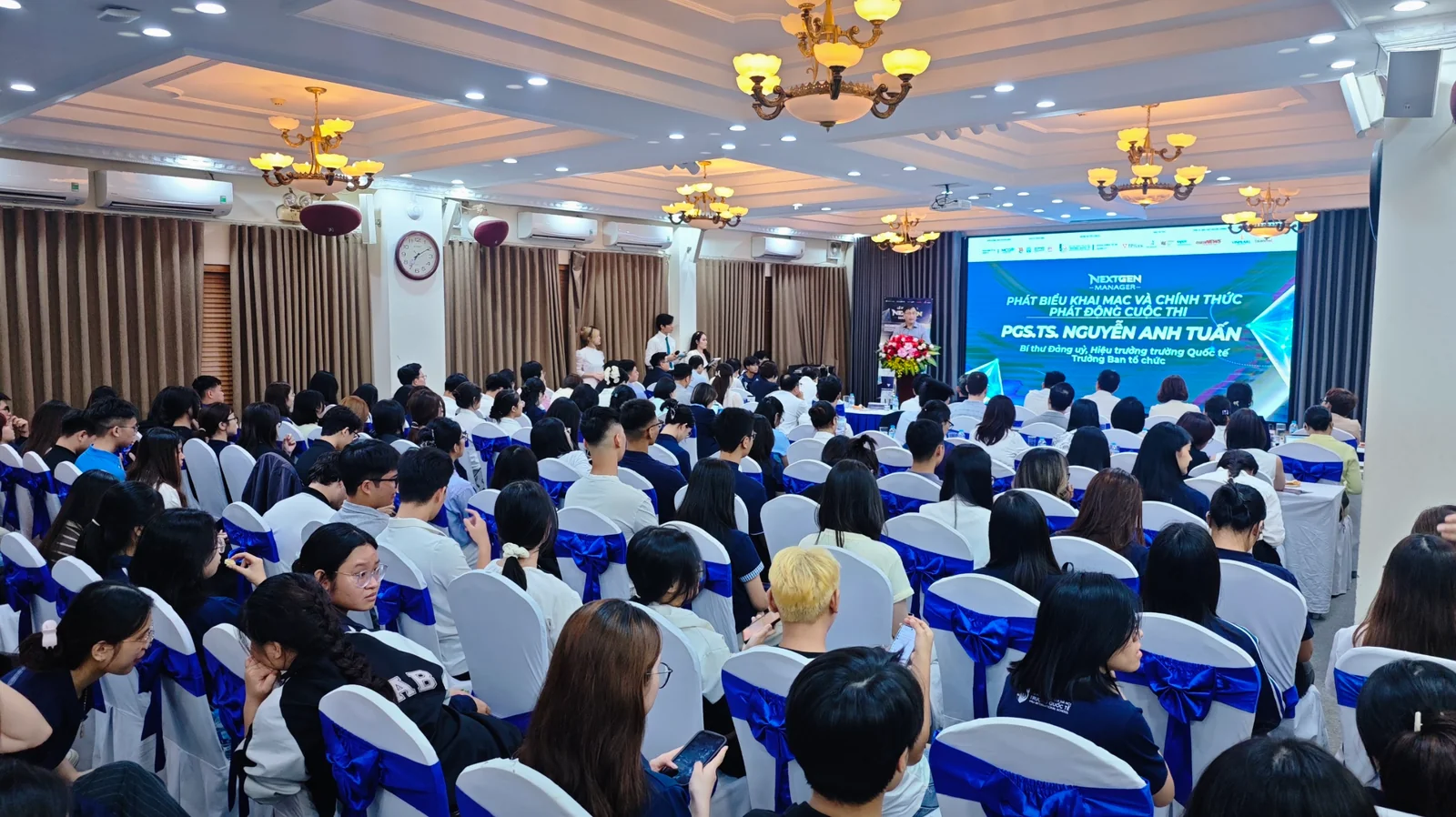
Speaking with reporters from VTC News Electronic Newspaper on the occasion of the recent launch of the NextGen Manager 2026 competition at VNU International School, Assoc. Prof. Dr. Nguyễn Anh Tuấn – Rector of VNU International School, Vietnam National University, Hanoi noted that a notable gap in contemporary higher education is evaluating students' decision-making capabilities in practical scenarios.
- The “inflation” of excellent and high-distinction degrees at many universities is causing widespread public concern. In your opinion, how should this issue be addressed?
At VNU International School, the proportion of graduates earning distinction or high-distinction honors is not high. Graduation honor rates are directly tied to an institution's evaluation standards and methods.

I believe we need to rethink how student learning competency is assessed. Traditional assessment methods (through exams and presentations) may not fully capture learners' genuine capabilities. Therefore, universities must develop new evaluation tools that assess the learning process and students' skills holistically.
Higher education institutions all aspire to assess students in the best possible way, and the Ministry of Education and Training is actively driving this innovation. I expect that modernizing evaluation methods across universities will be implemented more comprehensively and thoroughly, thereby better satisfying societal demands.
- University assessments are one matter, whereas the labor market, enterprises, and recruiters have their own distinct criteria for graduates. How can university assessments converge with real-world corporate expectations?
Currently, some higher education institutions experience a “time lag” in surveying and identifying the skills that the market truly demands.
In my view, designing and reforming curriculum must be grounded in rigorous, empirical surveys of market needs.
Furthermore, each enterprise may have distinct, specialized requirements. Therefore, universities cannot train solely to satisfy the bespoke needs of individual businesses, but must cultivate foundational competencies and skills aligned with general labor market standards.
VNU International School, like other institutions, is actively expanding surveys of actual market needs. The more objective and extensive the surveying process, the better universities can design appropriate training programs. Consequently, the gap between universities and the labor market will gradually narrow.
- Many graduates with stellar academic records face obstacles upon entering corporate environments. What do you consider the largest divide between lecture hall knowledge and market demands?
A top student can swiftly solve a clearly defined assignment. However, solving real-world business challenges requires independently identifying the core problem amidst disorganized circumstances. From this, three specific challenges emerge.

A top student can swiftly solve a clearly defined assignment. However, solving real-world business challenges requires independently identifying the core problem amidst disorganized circumstances.
First, making decisions with incomplete information. Classroom exercises generally provide comprehensive data points, whereas real-world work rarely does.
Second, prioritizing when multiple urgent and crucial matters arise simultaneously. A manager must allocate resources, identify what must be tackled first, and accept that not every task can be solved concurrently.
Third, persuading others without holding official formal authority. Collaborating with classmates is fundamentally different from influencing individuals who have no contractual obligation to follow you.
These capabilities cannot be cultivated merely by absorbing theoretical knowledge. Students must be immersed in scenarios where they must make choices, collaborate, resolve disagreements, and take responsibility for their chosen solutions.
“NextGen Manager” 2026 provides an avenue for domestic and international students to exchange perspectives, apply knowledge to practice, and thereby prepare thoroughly for the post-graduation professional environment.
- Which specific gap in current higher education does the NextGen Manager 2026 competition, themed “Portrait of a Manager in the AI Era”, aim to address?
We organize this competition not simply because AI is popular and trending today, but because AI exposes a gap that has long existed.
The educational gap lies in the fact that universities can measure theoretical knowledge relatively well, but assessing decision-making competencies in intricate real-world situations is far more challenging.
VNU International School has over 20,000 alumni across more than 24 years, with a relevant employment rate exceeding 93% within one year of graduation. While this is a commendable achievement, employment rates alone do not fully reflect how far graduates advance in their careers over subsequent years.
The competition is our vehicle to help students not only find suitable jobs but also recognize the competencies they must cultivate to progress further in the future.
Contestants are evaluated across six core competency groups: Analytical Thinking & Decision-Making; Systems Thinking & Prioritization; Leadership & Influence; Collaboration & Communication; Ethics & Responsibility; and Presentation & Language. Each group is described across five observable behavioral levels.
- VNU International School positions NextGen Manager as an annual competition. How will the School measure its long-term impact?
To evaluate long-term effectiveness, we plan to monitor four key metrics: the number of universities and academies with participating students each season; the proportion of finalists securing internship or employment offers from partner enterprises within 12 months; score progression in each competency group across seasons on the same assessment scale; and the number of Faculty learning outcomes or courses updated using competition assessment data.
Among these, the final metric is the most challenging, yet it most authentically demonstrates whether the competition generates tangible educational impact on academic curriculum.
We do not expect a single competition to resolve all challenges facing higher education. What matters most is maintaining evidence-based assessment that helps students understand where they stand, helps businesses recognize necessary competencies, and provides universities with data to continuously enhance training programs.
The NextGen Manager 2026 competition is organized by the Faculty of Economics and Management at VNU International School – Vietnam National University, Hanoi, open to university and academy students nationwide. Registration closes at 23:59 on October 31, 2026 at nextgen.vnuis.edu.vn. The competition comprises three rounds: Discover (Nov 7), Decide (Nov 21), and Deliver (Dec 5, 2026).
Lệ Thu
Source: VTC News Electronic Newspaper
English translation of the full original Vietnamese press article.