Creating an environment for Economics students to practice and assess managerial competencies
Original Vietnamese title: Tạo môi trường để sinh viên ngành Kinh tế rèn luyện, đánh giá năng lực
GD&TĐ - VNU International School (Vietnam National University, Hanoi) officially launched the NextGen Manager 2026 competition.
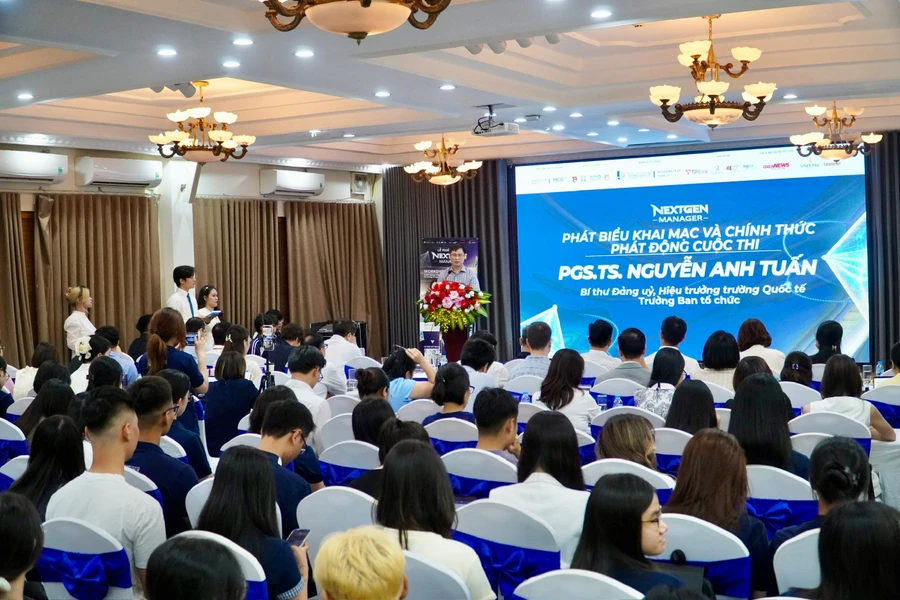
Organized amidst rapidly changing labor market demands for graduates—especially as artificial intelligence becomes increasingly widespread—the competition aims to create an environment where students can practice and evaluate managerial competencies through real-world business scenarios.
Rather than testing theoretical knowledge alone, NextGen Manager focuses on competencies such as analytical thinking, decision-making, prioritization, leadership, influence, collaboration, communication, and responsibility.
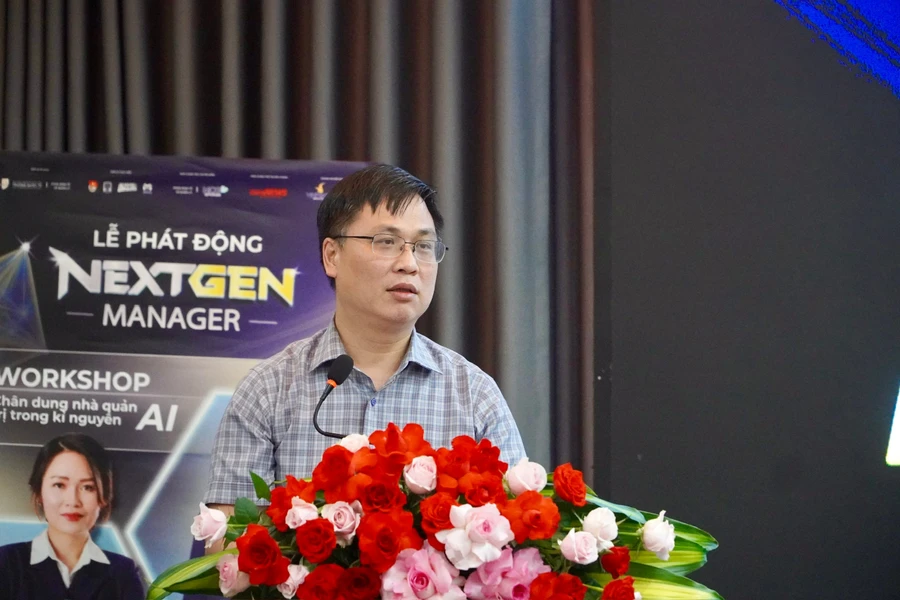
Speaking at the launch ceremony, Assoc. Prof. Dr. Nguyễn Anh Tuấn, Rector of VNU International School and Head of the Organizing Committee, stated: Every year, economics universities supply the labor market with thousands of graduates with strong academic transcripts. However, the competencies businesses need in a young manager—such as making decisions with incomplete information, setting priorities, or persuading others without formal authority—are difficult to measure through grades alone.
According to Assoc. Prof. Dr. Nguyễn Anh Tuấn, the rapid advancement of artificial intelligence makes this gap even more evident.
Artificial intelligence has raised the baseline output of work, shifting true differentiation toward capabilities that machines cannot easily replace. The challenge is not only training those competencies but also establishing reliable methods to measure how well learners have developed and mastered them.
A distinctive feature of NextGen Manager 2026 is its foundation on the Enterprise Assessment Center model—the methodology used by major corporations to select management trainees. Contestants are evaluated across six competency groups: analytical thinking and decision-making; systems thinking and prioritization; leadership and influence; collaboration and communication; ethics and responsibility; and presentation and language. Each competency group is defined across five observable behavioral levels.
Notably, the Grand Finale case study is provided directly by partner companies based on real management challenges. Every finalist receives an individual behavioral competency assessment report from corporate mentors, helping them identify strengths, address gaps, and plan further development.
The competition allows contestants to combine smart technology for research while maximizing their own reasoning and creativity. Partner businesses closely follow the submissions, and judges evaluate candidates according to the behavioral competency framework.
Clarifying this rule, Assoc. Prof. Dr. Nguyễn Anh Tuấn noted that there are three capabilities machines cannot replace: Asking the right question; Taking responsibility; and Leading others forward together.
Therefore, the competition permits contestants to use AI tools during their work. This is a deliberate choice rather than a concession: precisely because the competition measures capabilities AI cannot replace, allowing AI makes it even clearer who truly possesses those competencies.
“Contestants must declare their tool usage, and the way they declare it is scored under the ethics and responsibility competency group,” Assoc. Prof. Dr. Tuấn shared.
The competition consists of three rounds—DISCOVER, DECIDE, and DELIVER—corresponding to three fundamental requirements of a manager: understanding problems, making decisions, and delivering results.
Round 1 – DISCOVER takes place on November 7, featuring a video presentation and an online managerial thinking test to select the top 40 contestants.
Round 2 – DECIDE takes place on November 21 in a leaderless group discussion format. Contestants who have never worked together solve a practical corporate case study while judges observe and record behaviors to evaluate how they ask questions, resolve deadlocks, connect teammates, and guide the group toward results.
The Grand Finale – DELIVER is scheduled for December 5. Four teams solve a real business problem posed by partner companies and defend their proposals before the judging panel, after which the top 6 contestants advance to an individual round. This structure separately evaluates teamwork capability and independent decision-making.
Starting from Round 2, the Organizing Committee forms mixed teams of students from different universities, majors, and international students, creating a diverse working environment similar to real enterprises. VNU International School aims to make NextGen Manager an annual competition, building a bridge for universities and businesses to co-develop management competency frameworks for young leaders.
Alongside the three competition rounds, the program features corporate field trips and networking events connecting contestants with business leaders and experts, expanding internship and recruitment opportunities.
The competition features 8 awards with a total prize value exceeding VND 100 million at launch, including direct internship and employment opportunities at partner companies.
Registration is open until the end of October 31, 2026. The competition is open to undergraduate students from universities and academies both within and outside Vietnam National University, Hanoi, with no participation fee.
Đức Duy
Source: Education & Times Newspaper (Giáo dục & Thời đại)
English translation of the full original Vietnamese press article.